
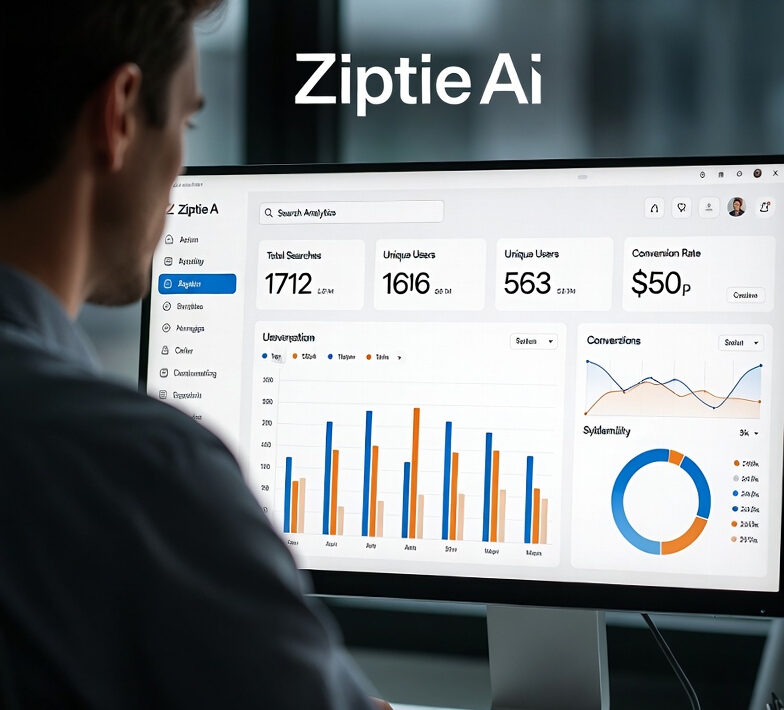
Introduction To Ziptie Ai Search Analytics
ZipTie is an analytics platform that helps businesses track their visibility in AI-powered search results. As search engines increasingly use AI to generate direct answers (like Google AI Overviews, ChatGPT, and Perplexity), traditional SEO metrics don’t tell the whole story anymore.
The platform monitors three key questions:
- Is your brand being mentioned in AI-generated answers?
- Are AI engines citing your website as a source?
- What’s the sentiment of those mentions?
It combines these into an “AI Success Score” that gives you a clear picture of your AI search performance across multiple platforms.
Built by the team behind SEO agency Onely, ZipTie is designed specifically for this new landscape where users might get AI-generated answers instead of clicking through to websites—making traditional ranking positions less meaningful than whether you’re actually included in those AI responses.
Who Created ZipTie And Why?
ZipTie was created by the team behind Onely, a technical SEO agency. The key people involved include:
- Tomasz Rudzki – Co-founder and CEO of Onely
- Bartosz Góralewicz – Co-founder of Onely
- Sebastian Skowron – Part of the Onely team
This team brings deep expertise in technical SEO and has been recognized in the search industry for their work helping enterprise clients navigate complex search optimization challenges.
Essentially, they created ZipTie because their work in SEO showed them that the rules of search visibility were changing, and businesses needed new analytics to adapt to an AI-first search world.
The AI Search Landscape
The way people search for information online is undergoing a fundamental transformation. Instead of receiving a list of blue links to click through, users increasingly receive direct AI-generated answers that synthesize information from multiple sources. Understanding this landscape is essential for anyone trying to maintain visibility in search results.
The Shift in Search Behavior
Traditional search engines displayed ranked lists of websites, and success meant appearing at the top of those lists. Users would click through to websites, scan content, and piece together their own answers. AI-powered search has flipped this model: the search engine itself now reads multiple sources, synthesizes the information, and presents a complete answer directly to the user.
This changes everything. A website that ranks #1 in traditional results might never appear in the AI-generated answer that users see first. Conversely, a site ranking #5 might be prominently cited because its content better matches what the AI determines is most relevant or authoritative.
Major AI Search Platforms
Google AI Overviews
Google AI Overviews (formerly known as Search Generative Experience or SGE) appears at the top of search results for certain queries (Ziptie) , providing AI-generated summaries before traditional search results. These overviews synthesize information from multiple sources and include citations to the websites used.
Key characteristics:
- Appears for informational and commercial queries
- Shows cited sources with links
- Can include images, videos, and structured data
- Continues to evolve in presentation and triggering conditions
- Represents Google’s hybrid approach—combining AI answers with traditional results
Impact on visibility: Even if your website ranks highly in traditional results below the AI Overview, users may find their answer without scrolling down, reducing click-through rates.
ChatGPT Search
ChatGPT has evolved beyond a conversational AI into a search engine that browses the web in real-time to answer queries. Unlike static training data, ChatGPT Search actively retrieves current information from across the internet.
Key characteristics:
- Conversational interface rather than traditional search results
- Provides real-time web information
- Cites sources within responses
- Allows follow-up questions for deeper exploration
- Integrates seamlessly with ChatGPT’s conversational capabilities
Impact on visibility: Brand mentions in ChatGPT responses can significantly influence perception, especially since users often treat ChatGPT as a trusted advisor rather than just a search tool.
Perplexity AI
Perplexity positions itself as an “answer engine” rather than a search engine (Ziptie) , designed specifically to provide direct answers with transparent sourcing. It’s built from the ground up for AI-native search rather than adapting traditional search infrastructure.
Key characteristics:
- Clean, focused interface centered on answers
- Strong emphasis on citations and sources
- Multiple AI models powering different features
- Related questions and suggested follow-ups
- Growing user base seeking alternatives to traditional search
Impact on visibility: Perplexity’s citation-heavy approach means being referenced as a source carries significant weight with users who value transparency.
Why Traditional SEO Metrics Fall Short
The metrics that defined SEO success for decades don’t capture performance in AI search:
Keyword rankings become less meaningful when there’s no ranked list—just an AI-generated answer that may or may not mention you.
Click-through rates don’t tell you whether your brand was featured in the answer that satisfied the user’s query without any clicks.
Backlinks matter differently—AI engines evaluate authority and relevance in ways that may not align perfectly with traditional PageRank-style algorithms.
Traffic volume might decline even as your brand influence grows, if AI engines cite your expertise without users needing to visit your site.
The New Success Metrics
In the AI search landscape, new questions matter more:
- Visibility: How often does your brand appear in AI-generated answers?
- Attribution: When AI engines provide information in your domain, do they cite you as the source?
- Sentiment: When your brand is mentioned, is the context positive, negative, or neutral?
- Share of voice: Compared to competitors, how prominent is your brand in AI responses?
- Commercial influence: For purchase-related queries, are your products recommended or mentioned?
The Hybrid Reality
It’s important to understand that we’re not in a purely AI-driven search world yet. The landscape is hybrid:
- Google still shows traditional results alongside AI Overviews
- Many users still prefer traditional search for certain tasks
- AI search adoption varies by demographic and use case
- Different platforms serve different user intents
Success requires optimizing for both traditional and AI search simultaneously, understanding that the balance is shifting steadily toward AI-generated answers.
Looking Ahead
The AI search landscape continues to evolve rapidly. New platforms emerge, existing ones refine their approaches, and user behavior adapts. What remains constant is the trend: users increasingly expect direct answers rather than lists of links, and the engines providing those answers determine which sources to trust and cite.
This is where tools like ZipTie become essential—they provide visibility into a landscape that traditional analytics simply weren’t designed to measure.
Why Choose Ziptie Ai Search Analytics?
1. First-Mover Advantage in a New Search Era
As AI-powered search fundamentally changes how people find information, ZipTie gives you visibility into a channel that traditional SEO tools weren’t built to track. You’re not just monitoring rankings anymore—you’re tracking whether AI engines actually recommend your brand when answering questions.
2. Purpose-Built for AI Search
Unlike general SEO tools trying to add AI features as an afterthought, ZipTie was specifically designed to monitor brand visibility within AI-driven search environments (Rankability) . It focuses exclusively on what matters in this new landscape: mentions, citations, and sentiment in AI-generated answers.
3. Multi-Platform Coverage
ZipTie monitors the three major AI search platforms—Google AI Overviews, ChatGPT, and Perplexity (Ziptie) —in one dashboard. Instead of manually checking each platform or using multiple tools, you get a unified view of your AI search presence.
4. Actionable Intelligence, Not Just Data
The platform doesn’t overwhelm you with metrics. Its smart prioritization system identifies which queries deserve your attention first by combining visibility data with commercial value, helping you focus optimization efforts where they’ll have the most impact.
5. The AI Success Score
This proprietary metric simplifies complex data into a single, trackable number that combines mention frequency, source citations, and sentiment. It gives stakeholders an easy way to understand and track AI search performance over time.
6. Expert Pedigree
Built by the team behind Onely, a respected SEO agency with deep technical expertise, ZipTie brings professional-grade insights and methodology. The founders understand both traditional SEO and the evolving AI search landscape.
7. Proactive Brand Protection
Beyond optimization, ZipTie helps you monitor how AI engines are characterizing your brand. If negative sentiment appears or competitors are being recommended over you, you’ll know immediately rather than discovering it months later through lost business.
8. Future-Proof Your Search Strategy
As more users rely on AI-generated answers instead of traditional search results, being invisible in AI responses means being invisible to potential customers—even if you rank #1 traditionally. ZipTie helps you adapt before your competitors do.
9. Technical Foundation Matters
The platform monitors indexing health and integrates with Google Search Console, recognizing that AI citation starts with proper technical SEO. You can’t be recommended by AI if you’re not properly indexed.
10. Fill the Gap in Your Analytics Stack
Your current tools likely track rankings, traffic, and conversions—but they can’t tell you if ChatGPT is recommending your competitor when asked for product suggestions in your category. ZipTie fills this critical blind spot.
11. Competitive Intelligence
See not just your own AI visibility but also which competitors are being cited, for which queries, and on which platforms. This intelligence is nearly impossible to gather manually at scale.
12. Align with Changing User Behavior
Users increasingly accept AI-generated answers without clicking through to websites. If you’re not part of those answers, you’re losing visibility regardless of your traditional search rankings. ZipTie helps you stay relevant as behavior shifts.
Choose ZipTie if you recognize that AI search is not a future trend but a current reality reshaping how customers discover brands, products, and services. Traditional SEO tools measure yesterday’s metrics; ZipTie measures what matters today and tomorrow in an AI-first search world.
How To Use Ziptie Ai Search Analytics
Starting with ZipTie is designed to be straightforward, even if you’re new to AI search optimization. Here’s your complete guide to getting up and running.
Step 1: Sign Up and Start Your Free Trial
ZipTie offers a 14-day free trial to explore all features , and the good news is you no longer need to enter credit card details to use the trial . You’ll only be asked for payment information if you decide to continue with a paid plan after your trial ends.
To get started:
- Visit ZipTie.dev
- Click “Start Free Trial” or “Get Started”
- Create your account
- You’ll be taken to your dashboard
Step 2: Initial Setup and Configuration
Once you’re in, the platform guides you through a step-by-step setup process:
Dashboard Overview
- When you first log in, you’ll see the dashboard panel with a summary of your projects, integrated GSC properties, indexation checks and alerts, recent checks shortcuts, and other useful info . The interface is designed to be user-friendly and requires no specific SEO expertise.
Google Search Console Integration (Optional)
- For more comprehensive tracking, you can integrate your Google Search Console account. This connection helps ZipTie provide deeper insights into your site’s overall performance and indexing health.
Step 3: Add Your Queries/Prompts
This is where you define what search queries ZipTie should monitor. You have two options:
Option A: Use the AI Query Generator (Recommended)
- ZipTie includes a query/prompt generator where an AI assistant will identify relevant search terms for your business (Ziptie) . This is particularly helpful if you’re unsure which queries to track or want to ensure you’re covering all important topics.
Option B: Manually Add Queries
- If you already know which questions and searches matter to your business, you can add them manually. Think about:
Questions customers commonly ask
- Product-related searches
- Industry topics where you want visibility
- Branded searches
- Competitive comparisons
- Understanding Credits
ZipTie operates on a credit system. Every keyword monitored costs 25 credits , and different actions consume different amounts of credits. Your plan determines your monthly credit allocation.
Step 4: Wait for Your First Check
After adding queries, your check might take up to 1 hour (Ziptie) to complete. ZipTie mimics real user behavior across Google AI Overviews, ChatGPT, and Perplexity to capture authentic results, which is why it takes time rather than relying on instant API calls.
Step 5: Review Your Results
Once your initial check completes, you can start exploring your data:
Navigate to the Queries Tab
The Queries tab provides detailed statistics for each individual search term, including AI Success Scores and performance indicators for each monitored AI search engine (Ziptie) . Click on any query to see:
- Whether your brand is mentioned
- If your website is cited as a source
- The sentiment of mentions
- Performance across each AI platform
- Understanding Your AI Success Score
- The platform combines three key metrics into your AI Success Score:
- Mention frequency (how often your brand appears)
- Citation presence (whether you’re referenced as a source)
- Sentiment analysis (positive, negative, or neutral)
- Filter by Tags
You can filter results by tags to see your success for specific topics, product categories, or content types (Ziptie) , helping you understand which areas of your business perform well and which need improvement.
Step 6: Set Up Indexing Monitoring (Optional but Recommended)
ZipTie also monitors which of your pages are indexed by search engines, which is crucial since unindexed pages cannot be cited by AI engines.
To get started, go to the dashboard and choose Indexing Monitoring to enter an audit setup. There are three options to provide URL sources: Sitemaps, URLs List, and Crawl (Robertgoldenowl) :
- Sitemaps: The tool checks URLs from your sitemap (you can add RegEx filters)
- URLs List: Paste or upload a list of specific URLs to check
- Crawl: Let ZipTie crawl your website organically
Step 7: Start Optimizing
Once you understand your current position, you can begin improving:
Use Content Optimization
- For underperforming queries, scroll down to the AI Optimizations section on the query detail page. Paste the content you want to optimize into the text box (Ziptie) , and ZipTie will analyze what’s missing and provide specific recommendations.
Review the Insights Tab
- Check the Insights tab for ideas and suggestions prepared specifically to help you succeed in AI search.
Tips for Success
- Start Small: Begin with 10-20 of your most important queries rather than overwhelming yourself
- Check Regularly: Set a schedule to review your AI Success Scores weekly
- Prioritize Actions: Focus on queries with high commercial value but low AI visibility first
- Be Patient: AI search optimization takes time; check results over weeks rather than days
- Use Tags: Organize your queries with tags from the start to make filtering easier later
Understanding Pricing Plans
As you approach the end of your trial, you’ll need to choose a plan:
- Basic Plan: Starts at $29 and provides 10,000 credits per month
- Standard Plan: $89, needed if your project needs more credits or GSC integration
- Agency Plan: $849 per month with outstanding capabilities for auditing clients’ websites
- Custom Plans: Available starting at $1000 for specific needs
Getting Help
If you need assistance:
- Check the FAQ section on ZipTie.dev
- Use the contact form for specific questions
- Consider their professional services for in-depth audits and optimization support
- Press the thumbs down on any report if something seems off
With these steps, you’ll be tracking your AI search presence and making data-driven optimization decisions within your first day on the platform.
Conclusion On Ziptie Ai Search Analytics And Why Choose Ziptie Ai Search Analytics.

ZipTie is more than an analytics platform; it’s a bridge to understanding Generative Engine Optimization (GEO). By tracking your AI Success Score across multiple platforms, monitoring citations, analyzing sentiment, and identifying optimization opportunities, it provides the actionable intelligence needed to adapt your content strategy for the AI era. The platform doesn’t just tell you where you stand—it helps you understand what to do about it.
What sets ZipTie apart is its focus on practical action. The query prioritization system helps you focus efforts where they’ll have the most impact. The content optimization features provide specific recommendations rather than vague suggestions. The indexing monitoring ensures you’re not overlooking fundamental technical issues. Every feature is designed to answer the question: “What should I do next?”
As AI search continues to evolve and expand, the businesses that thrive will be those that adapt early. ZipTie provides the foundation for that adaptation—helping you understand current performance, identify gaps, track improvements, and stay ahead of competitors who are still relying solely on traditional SEO metrics.
Whether you’re a solo entrepreneur monitoring brand mentions, a content team optimizing for AI visibility, or an agency managing multiple clients, the platform scales to meet different requirements.
The question isn’t whether AI search will impact your business—it already has. The question is whether you’ll have the visibility and insights needed to navigate this new landscape effectively. ZipTie provides those insights, transforming an uncertain future into measurable, manageable opportunities.